Thursday, July 21, 2011

South Yorks NUJ strikers launch 'bootleg' papers


Striking NUJ journalists at the Johnston Press-owned South Yorkshire Newspapers are producing 'bootleg versions' of the Doncaster Free Press, South Yorkshire Times and Selby Times for readers as part of their industrial action against management decisions to cut jobs and close offices.

News of the Dearne appeared in Mexborough today with the strapline: "Hacking off Johnston Press since 20o11" and a feature on the issues behind the strike.

The union says the journalists have made the move to publish their own papers because they do not want their readers and communities to miss out on the real news while their indefinite strike continues.

One of the NUJ members said: "We are determined to win our strike, but we feel a real responsibility to our readers and are determined to give them the best service they can get.

"We also want to show management that we are willing and more than able to produce quality journalism under the most difficult of circumstances.We just wish our bosses would give us the opportunity to do that while we were at work."
The first issues of all three newspapers focus on the strike but next week's newspapers plan to carry news from all three towns.

One of the strikers' ideas was to call their Selby paper the News of the (scr) Ouse.

Labour Leader Ed Miliband tweeted today: "Hope the issues are resolved soon. I’ve always appreciated what Free Press and SYT do – their campaigns and stories are vital." He has come under fire from the NUJ for ignoring the dispute, despite being a local MP (see post below).

MPs urge Leveson to back 'conscience clause' to combat development of sewer journalism culture


MPs John McDonnell (top) and Austin Mitchell are urging Lord Leveson, who is heading the inquiry into media ethics, to recommend legislation for a "conscience clause" for journalists which would stop them being sacked for refusing to break the code of conduct.

In a letter to the Guardian today the MPs, both members of the NUJ parliamentary group, state: "On several occasions over recent years, we have proposed amendments to employment legislation to introduce a conscience clause to protect journalists who refuse to undertake editors or press owners' instructions to do anything against the journalists' code of conduct. This would help protect journalists who refused to stoop to practices which they regard as unethical.

"When the Employment Relations Act was going through parliament in 2004, we sought to introduce a conscience clause amendment which would have ensured that any attempt to dismiss a journalist for obeying the Press Complaints Commission code of practice would have been unlawful and therefore actionable in respect of compensation.

"All the main parties refused to support our amendments. Giving the code of conduct statutory force would help protect journalists against undue pressure from editors, and also prevent the development of a sewer journalism culture. Our hope is that the Leveson inquiry will recommend legislation to introduce a conscience clause."

Speaking in the Commons on the Leveson inquiry, McDonnell pointed out that the NUJ code was first development in 1936.

Asked if the one of the most important results of the Levenson inquiry would be "a media that tells the truth", McDonnell replied: “I think that we will arrive at that situation only if we enforce the code of conduct and if journalists and employers know where they stand and that, if they breach the code, journalists can stand up and be protected in law if they refuse to practise the sort of journalism we have seen recently.

"I urge the Leveson inquiry to examine the introduction of a conscience clause backed by statute to protect journalists who refuse to go into the sewer and use the methods that we have all condemned in these recent debates.

"The Leveson inquiry should consider anti-trade union legislation, which has been used to undermine employees’ rights at places such as News International when unions have tried to protect members who have simply stood up for quality and ethical journalism.”

Local press and Leveson Inquiry:

The Prime Minister referred to the “strong case for recognising the importance of a strong regional and local newspaper industry”, avoiding “punishing the innocent.. providing good local newspapers” and the work of the local press with the police to help beat crime, in the course of Wednesday’s debate on Public Confidence in the Media and Police.

David Rutley (Macclesfield) (Con) asked : “Like many other Members, I am sure, I have been contacted by local newspapers which are concerned about the prospect of new regulation at a time of increasing pressure on their circulation. Can my right hon. Friend assure them that new regulations will not be overly heavy-handed on local press?”

The Prime Minister replied: “My hon. Friend makes a good point. We do not want a new regulatory system to punish the innocent, as it were, who are just providing good local newspapers, but there are problems with ethics and issues that need to be looked at. We need to make sure that it is proportionate….”

Nigel Mills (Amber Valley) (Con) asked: “After a decade of spin, I welcome the Prime Minister’s attempt to sort out the relationship between politicians and the media for the long term, not just to manage the news cycle. Will he recommend that Government Departments, local councils and quangos start dispensing with all their own spin doctors so that we can be truly rid of that spin culture?”

The Prime Minister replied: “My hon. Friend makes a good point. An enormous amount of money is still spent by local authorities on their own free local newspapers. That is injurious to the newspaper industry. There is a strong case for recognising the importance of a strong regional and local newspaper industry….”

  • Pic: Jon Slattery

Wednesday, July 20, 2011

NUJ welcomes Leveson inquiry into media ethics and calls for tough penalties for code breakers


The NUJ has welcomed the terms of Lord Justice Leveson's inquiry into media behaviour and called for tough penalties for organisations that break the union's code of conduct.

The union says it offers the opportunity to create a serious regulatory body across the media which would work to uphold ethical standards and guarantee protection for journalists determined to abide by the NUJ code of conduct.

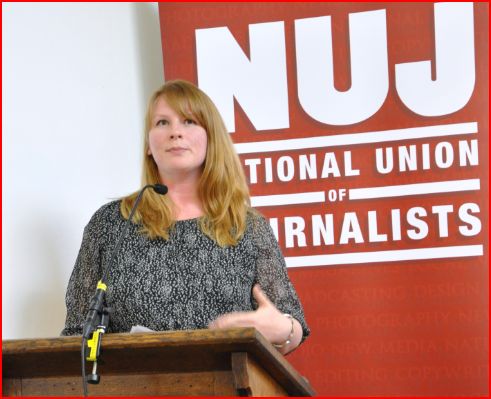
The self-regulatory body should provide for serious penalties for media organisations which break the code, said NUJ general secretary Michelle Stanistreet (top), as well as offering a reliable mechanism to deal with complaints from the public.

“Central to the development of an ethical environment for modern journalism must be a guarantee that journalists who uphold professional standards will be protected against management pressure to chase circulation by behaving unethically,” she said.

“No journalist should be threatened with the sack for standing up for quality journalism. The Murdoch scandal has created circumstances in which the media, journalists, and society as a whole can now move forward and design a new model of self-regulation which serves the interests of the public and the media industry in an honourable way.

“The Leveson inquiry must also address the issue of media ownership across the entire newspaper industry. The NUJ has drawn attention to the damage being done by media giants who have swallowed up and asset-stripped so many of our local and regional newspapers. The damage done to the quality of local journalism, as jobs are axed and content compromised, is a threat to democracy as well as a disservice to loyal local readers."

The remit of the Leveson inquiry will include broadcasting and social media. Two of the six people working with Lord Justice Levenson are journalists, the former political editor of Channel 4 News, Elinor Goodman, and the former political editor of the Daily Telegraph, George Jones.

The others are the former Ofcom director David Currie, Liberty director Shami Chakrabarti, Sir David Bell, the former chairman of the Financial Times, and Sir Paul Scott-Lee, a former police chief.

The NUJ has already revived its call for a "conscience clause" which would protect journalists from the sack if they refused to do unethical journalism in breach of the code of conduct.

Pic Jon Slattery

Where's Ed? Labour leader accused by NUJ of ignoring strike over jobs at his local paper


Labour leader Ed Miliband is being criticised by the NUJ for ignoring a strike by local journalists in his own constituency while concentrating on attacking the Murdoch empire.

The indefinite strike involves job cuts, including that of the post of editor, at the Johnson Press-owned South Yorkshire Times, based in Mexborough in the heart of Miliband's Doncaster North constituency.

NUJ official Lawrence Shaw, who covers the north of England for the union, writes on his blog about the Labour leader: "Well OK, we know where he is. He’s on the Murdoch-bandwagon. And, to be fair, who can blame him? Not many people disagree with him on dismantling the media empires at the moment.

"But he’s entirely ignoring another major media crisis. One within his own constituency."

Shaw adds: "Labour MPs, even shadow ministers, have already been supportive. John Healey who represents the neighbouring constituency to Ed has voiced his strong support for the NUJ’s position calling for the company to think again about the cuts.

"But Ed has said nothing. Replied to no direct communication from the NUJ, or any of the members who have contacted him in relation to this dispute.

"Ed doesn’t have to agree to the NUJ strike action, or turn out on a picket line. But as a politician in the spotlight who is going for the jugular of the biggest beast on media ownership, why is he not also taking the opportunity to attack the companies, and their systems of private debt, that are largely destroying our fragile local newspaper industry?

"His abject failure to even comment on a crisis taking place on his doorstep lead me and all NUJ members involved to the conclusion that his grand talk about media ownership is little more than posturing. If Ed really cared about sorting out the media in the UK, he would address more than just Murdoch’s empires and the national papers."
  • The striking journalists have the support of former world darts champion Dennis "the Menace" Priestley who joined the picket line at the South Yorkshire Times' Mexborough office. He said: "I am very concerned the newspaper will lose its local identity in this move. I'm a loyal Times reader".

UNICEF urges news media to 'move on' from phone hacking and focus on famine in Somalia


UNICEF UK has taken out ads in the national press today highlighting the famine in southern Somalia and urging readers to move the news agenda on from phone hacking.

The ad, in the form of a letter from UNICEF UK executive director David Bull, states: "I am writing for your support in moving the news agenda on.

"The story about phone hacking does matter, but there's another, far bigger and vital story that's going un-reported.

"This morning, the United Nations will formally declare a famine in parts of southern Somalia."

The phone hacking saga continued to dominate the UK news agenda in the week ending Sunday, July 17, according to journalisted.

The hacking scandal with new resignations, new victims, and a shift of focus onto the Metropolitan Police generated 1,310 articles; The Open, held at Royal St. George's, Sandwich, Kent, won by popular Northern Irish golfer Darren Clarke, 357 articles; new addition to the Beckham family, Harper Seven, 81 articles; Eurozone countries undergo stress tests to see if they could withstand another financial crisis, 79 articles; new bouts of violence in Northern Ireland after Orange Order parades, 41 articles.

Covered little, according to journalisted, Theresa May announces that UK terror threat has been reduced to 'substantial', 12 articles; more Olympics tickets controversy, as around 700 people get charged twice for their tickets, 4 articles; the Libyan rebel Transitional National Council is officially recognised by world powers as the 'legitimate governing authority', 6 articles.

Tuesday, July 19, 2011

Brooks: 'All Fleet Street used private investigators'


Ex-News International chief executive Rebekah Brooks told the Culture, Media and Sport Select Committee the News of the World used private investigators when she was editor as she claimed did "every newspaper in Fleet Street".

She said her use of private investigators while editor of the News of the World was legitimate and part of the paper's Sarah's Law campaign to track down and identify paedophiles which was in the public interest.

Brooks said she had never met the private investigator Glenn Mulcaire and had not heard his name until he was arrested in 2006.

She also said she felt "sick and disgust" when she heard the allegations that Milly Dowler's phone had been hacked. Brooks said she only knew about it when the story broke in the media in the last few weeks.

"I don't know anyone who would sanction listening to Milly's phone. This is the most shocking thing I've heard about potential journalists at News international."

She said a newsroom was based on trust and editors had to rely on their journalists behaving in a proper manner.

Brooks said she had never authorised a payment to police or gone horse riding with the Prime Minister.

Rupert Murdoch 'humble' before Parly Committee


News Corporation chief Rupert Murdoch told the Parliamentary Culture, Media and Sport Select Committee hearing into phone hacking today: "This is the most humble day of my life."

He said he was "absolutely shocked, appalled and ashamed" when he heard that Milly Dowler's phone had been hacked.

Murdoch said News International would make every effort to make sure News of the World staff would be offered new jobs if they were "not part of the group involved in criminality".

He told the committee David Cameron had invited him to Downing Street for tea to thank him for his support at the last General Election.

Asked who was responsible for the phone-hacking crisis, Murdoch said: "The people I trusted and the people they trusted." He said he would have trusted former News International chairman Les Hinton with his life.

Murdoch denied that closing the News of the World was a commercial decision, commenting "far from it," and claimed the UK benefited from a competitive press.

He said he and had been close to Gordon Brown but the former Prime Minister had never raised phone hacking with him. Murdoch said investigative journalism led to a more open and transparent society but journalists should never break the law.

News Corp's deputy chief operating officer James Murdoch told the committee that there was "no immediate plan" to replace the News of the World with a new Sunday paper.

He said he welcomed the inquiry into media ethics and said "the industry as a whole" needed to decide what sort of governance was required.

James Murdoch said he was "shocked" to discover that News International was paying towards private investigator Glenn Mulcaire's legal fees.

The Committe was suspended after demonstrator tried to attack Rupert Murdoch with what appeared to be a plate of shaving foam.

When it resumed, Rupert Murdoch was asked if he had considered resigning. He said it was for those who "betrayed" the company to pay.

In a statement to the Committee, Rupert Murdoch said: "My company has 52,000 employees. I have led it for 57 years and I have made my share of mistakes. I have lived in many countries, employed thousands of honest and hardworking journalists, owned nearly 200 newspapers and followed countless stories about people and families around the world.

"At no time do I remember being as sickened as when I heard what the Dowler family had to endure – nor do I recall being as angry as when I was told that the News of the World could have compounded their distress. I want to thank the Dowlers for graciously giving me the opportunity to apologise in person.

"I would like all the victims of phone hacking to know how completely and deeply sorry I am. Apologising cannot take back what has happened. Still, I want them to know the depth of my regret for the horrible invasions into their lives.

"We now know that things went badly wrong at the News of the World. For a newspaperthat held others to account, it failed when it came to itself. The behavior that occurred went against everything that I stand for.

"It not only betrayed our readers and me, but alsothe many thousands of magnificent professionals in our other divisions around the world.So, let me be clear in saying: invading people’s privacy by listening to their voicemail iswrong. Paying police officers for information is wrong. They are inconsistent with ourcodes of conduct and neither has any place, in any part of the company I run."

He concluded: "Above all, I hope that, through the process that is beginning with your questions today, wewill come to understand the wrongs of the past, prevent them from happening again and,in the years ahead, restore the nation’s trust in our company and in all British journalism."
 

FREE HOT VIDEO 1 | HOT GIRL GALERRY 1

FREE HOT VIDEO 2 | HOT GIRL GALERRY 2

FREE HOT VIDEO 3 | HOT GIRL GALERRY 3

FREE HOT VIDEO 4 | HOT GIRL GALERRY 4

FREE HOT VIDEO 5 | HOT GIRL GALERRY 5

FREE HOT VIDEO 6 | HOT GIRL GALERRY 6

FREE HOT VIDEO 7 | HOT GIRL GALERRY 7

FREE HOT VIDEO 8 | HOT GIRL GALERRY 8

FREE HOT VIDEO 9 | HOT GIRL GALERRY 9

FREE HOT VIDEO 10 | HOT GIRL GALERRY 10

FREE HOT VIDEO 11 | HOT GIRL GALERRY 11